
Having an emergency plan in place if you believe you or a loved one is at risk of being detained can help ensure needed information is readily available in case a loved one is detained.
While it’s difficult to think about during this stressful and scary time, you and your loved one DO have rights, and there are things you can do to ensure your rights are protected.
On this page you can find information related to:
- First steps: MY LOVED ONE IS DETAINED, START HERE
- Find Where Your Loved Is Detained
- Gather Important Information
- Coordinate Legal Representation
- Support Loved Ones in Detention
- Rights of Those Who are Detained
- Financial Assistance
- Bail Funds
If you would like support or help in supporting your loved one, or for any of the following, please email uvimmsolidarity@pm.me
- Supporting a Loved one prepare to get out of detention/fight their deportation case
- Finding legal support/services (trusted private and pro bono, financial support, bond/habeas representation)
- Bond support (paying bond, support letters)
- What documents to gather immediately
- Financial assistance (legal, bond)
- What is habeas and why is it a powerful tool?
- What to expect one someone is released on bond or of their own recognizance (i.e. follow up check ins/interviews, GPS ankle monitor)
- Post-release ride requests
Note that any information contained here is informational, NOT legal advice. Please consult with your lawyer about your specific situation.
- Ensure pets, children, other dependents are cared for
- Follow your loved one’s emergency preparedness if they have one. If not, work with other family members, friends, neighbors, and other trusted community members to ensure their pets, children, and other dependents are safe and cared for. In some cases this may involved working with school or healthcare personnel who need to follow strict privacy laws
- Contact their lawyer, if they have one.
- If your loved one has an immigration attorney, you should contact them as soon as possible to let them know your loved one was detained. If they have any pending criminal charges, even minor ones, and they have a criminal defense lawyer, you should contact them as well.
- Find their A#
- What is an A#?
- An A# is an identification number issued to a person by Immigration and Customs Enforcement (ICE), Customs and Border Patrol (CBP), or U.S. Citizenship and Immigration Services (USCIS). It typically has 8 or 9 digits.
- If your loved one previously filed an immigration application with USCIS, were picked up by CBP, or had a CBP One appointment, they will likely already have an A# that you can find in their immigration documents.
- However, if your loved one came to the U.S. on a nonimmigrant visa and
overstayed, they may not have one yet. - If a detained person does not already have an A#, ICE will issue one to them. A person’s A# should be listed on any papers they receive from ICE or the immigration court, as well as on their detention facility identification card and/or bracelet.
- If your loved one has an immigration attorney, their attorney should be able to provide you with their A# if you don’t already have it.
- Why is it important?
- A detained person’s A# serves several important purposes. It can be used to locate where they
are detained. It can also be used to find out whether they have an upcoming immigration court
hearing, and if so, where and when the hearing will take place.
- A detained person’s A# serves several important purposes. It can be used to locate where they
- How do I find their A#?
- There are many places you might find an A#, including a green card, employment authorization document, visa, Notice of Action from DHS, and more. See more details here. Examples include:
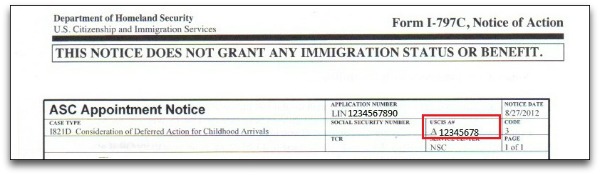
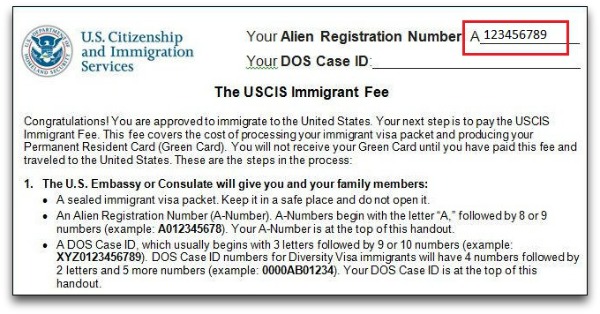
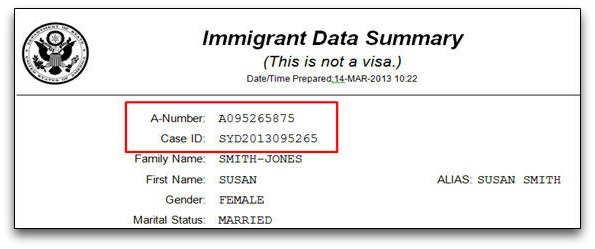
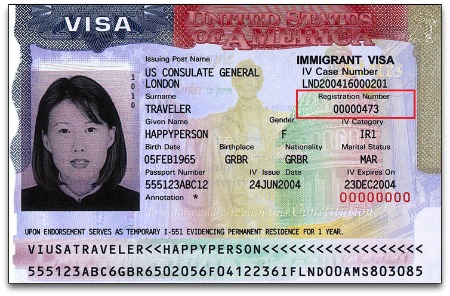
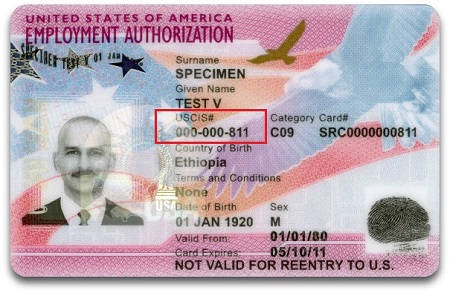
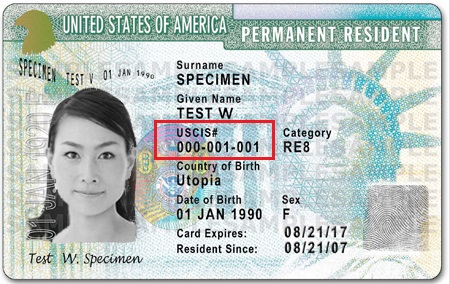
- An A# is an identification number issued to a person by Immigration and Customs Enforcement (ICE), Customs and Border Patrol (CBP), or U.S. Citizenship and Immigration Services (USCIS). It typically has 8 or 9 digits.
- What is an A#?
- To locate your friend/family member after they have been detained by ICE, go to locator.ice.gov.
Then search for them by typing in their A# (without any dashes) and country of birth.
- Most A#s are 9 digits. If your loved one’s A# is only 7 or 8 digits, you should add one or two zeros at the start to bring it to 9 digits– for example, 11111111 would be entered as 011111111
- Most A#s are 9 digits. If your loved one’s A# is only 7 or 8 digits, you should add one or two zeros at the start to bring it to 9 digits– for example, 11111111 would be entered as 011111111
- If you do not know the person’s A#, or if they do not have one, you can try using their first and last name, date of birth, and country of birth to locate them within the ICE detention system.
- Keep in mind that you may need to try different variations or spellings of their name, such as adding a hyphen between two last names, or using only one of their last names. For this reason, it is easiest to search for someone using an A#, if they have one.
- If the person you are looking for appears in the results, you can click on the hyperlinked name of the place where they are detained for more information about that facility and the ICE field office in charge of it.
- If you believe your loved one is detained in Vermont, go to https://www.vticedetaineetracker.net/
Collect as much of the following information and documents as possible:
- Basic Information –
- Record their full legal name and address.
- Record any other names they may have gone by in the past.
- Record family information such as spouse, children, and other live-in relatives/ friends.
- A-number and country of birth
- Where and when they were detained
- Current medications, treatments, or medical conditions
- When they most recently entered the country, and any previous involvement with USCIS, DHS, or other entities related to immigration and refugee services or enforcement.
- Immigration/ Criminal Information – Collect any prior immigration applications filed and receipt notices, as well as any police reports, probable cause affidavits, charging documents, and sentencing documents.
- Gather Important Documents –
- Immigration-related documents
- Examples: I-94, notices from the immigration court or the Board of Immigration Appeals (BIA), copies of family members’ USCIS applications and their receipts.
- If your loved remembers being in immigration court or filing an immigration application in the past, but does not have records of these on paper, you can help them file a Freedom of Information Act (FOIA) request with USCIS. To learn more about filing a FOIA request with USCIS, see this guide from USCIS or this guide from the Asian-American Legal Defense and Education Fund (AALDEF)).
- Documentation of interactions with local, state, or federal law enforcement
- If your loved one has ever faced criminal charges or been arrested by the police– local, state, or federal– gather records of this as soon as you can, even if they were not convicted.
- If your loved one had a criminal defense attorney or public defender, you can start by reaching out to them and asking if they can provide copies of any relevant records.
- If you know the docket number of their criminal case, you can go directly to the court where their hearings were held and request records of the disposition.
- If your loved one or one of their immediate family members (minor children or spouse) was the victim of a crime, you should get a copy of the police report.
- If your loved one has ever faced criminal charges or been arrested by the police– local, state, or federal– gather records of this as soon as you can, even if they were not convicted.
- Remember: if you need to send documents or records to your detained loved one, mail ONLY copies and keep the originals somewhere safe.
- Immigration-related documents
- Emergency Plan – Does the person who was detained have an emergency plan for them and their family? Collect and review all documents they have prepared.
- Detention Incident – Describe everything that happened, starting with when you first realized agents were present? Who else was present? Was anyone else detained? What did the agents say? Did they aggressively touch or move anyone? Was anyone hurt? Do you have other concerns about how they treated you?
- If this was a workplace, has the employer been notified? Are there concerns that agents might return? Do the workers feel prepared for how to defend their rights?
- If this was a neighborhood, do your neighbors already communicate with each other via WhatsApp or another chat? Do you feel prepared to identify agents if they come back?
- Collecting Paperwork: Individuals who are concerned they may be detained should consider collecting paperwork ahead of time
- Make copies of any paperwork or identification you have.
- Only carry copies, not original of anything. When folks are being picked up and being detained, those documents are being taken from people
- Original copies should be kept in a safe and locked location where a trusted friend, colleague, or family member has access to.
- Include A#s in paperwork
- Gather letters in advance if concerned about being detained: Community support, proof of employment, firm address. These can support habeas and bond requests.
A note regarding other documents, including letters of support:
Prioritize gathering the immigration and criminal history documents listed above because they are important for an lawyer to be able assess your loved one’s case. They can also take a long time to get. The more of these important documents you have ready, the easier it will be for an attorney to give your loved one a thorough legal consultation and advise them on what to do next.
It may also be helpful to gather copies of:
- any government-issued identification documents the detained person may have (e.g. driver’s license, passport, cedula), as well as their birth certificate.
- evidence of lawful status of immediate family members (spouse, parents, children), such as copies of birth certificates, certificates of naturalization, LPR cards, U.S. passports.
You should wait to speak to an attorney before you gather other documents not listed above, like letters of support, because many cases will not benefit from letters of support. In the event your loved one’s case would benefit from letters of support, an attorney can advise you on what to include to make sure they are helpful and relevant for your loved one’s case.
Immigration cases for detained people move quickly, and it is important to quickly coordinate legal representation for the individual who has been detained. To find a lawyer, check out the resources below.
It is important that everyone be prepared for the reality that not everyone is going to be able to access an immigration attorney: harm is going to happen, we are in the reduction space as much as possible now
- Find Legal Support in Vermont: https://www.vaapvt.org/legal-support
- This is the central intake for all immigration attorneys across Vermont.
- Requests may be referred to other organizations and attorneys across Vermont
- If person is a refugee: AALV or USCRI
- Legal Help for People Detained in Maine or Strafford, New Hampshire: ILAP accepts requests for legal assistance regarding immigrants detained in Maine and Maine residents detained at the Strafford County Department of Corrections in New Hampshire. Please use ILAP’s intake form to request help for a person detained in these locations.
- Use this resources to identify immigration attorneys: Immigration Advocates Network
- Watch out for Fraud – There is a list of Currently Disciplined Immigration Practitioners. If your lawyer is on this list, cease communication. Get a new lawyer.
- Additional Reading – We also recommend you check out these Do’s and Dont’s with Your Legal Representative and Common Scammer Actions of people offering immigration assistance. You can also check out this Electronic folder of resources and LUCE Legal Resources Folder Legal Help for more.
- Paying commissary and making phone calls:
Unlike the criminal court system, the immigration court system does not provide a free lawyer if you cannot afford one. Here are some tips for finding a lawyer or accredited representative who can help you:
- Your detained loved one should reach out to more than one organization/lawyer, and should keep calling until they reach someone. It can be difficult to get through to lawyers and legal services organizations by phone, and can take a long time to reach a real human.
- In Vermont, you can request legal support by going to https://form.jotform.com/262035258878164.
- If you can call or email on the detained person’s behalf, this may help things move faster. It is okay if you do not speak English fluently, or at all. Most legal services offices contract with language services, and can arrange for interpretation or translation as needed.
- If your detained loved one does not have an immigration lawyer or DOJ Accredited Representative by their first hearing, they should ask the immigration judge for more time to find a lawyer.
- Be careful of fraud or false promises. Notarios, or notaries, are not always lawyers in the United States. Immigration law is complicated, so it is important to look for a lawyer who is experienced in immigration law (ideally with detained cases). Be wary of anyone who promises you a certain result for your loved one’s case. Someone who guarantees a result is probably not being honest with you.
- If you speak to your loved one, remind them not to sign anything without speaking with a lawyer first.
Coordinating financial assistance for your loved on can be difficult, and should include keeping in mind: Bail Bond, Commissary, Legal Fees, and Family Finance Assistance. The following organizations are growing and may be able to help:
- Vermont: https://www.vermontlegaldefensefund.com/
- New Hampshire Community Bail Fund:
- MA and RI: https://www.beyondbondboston.org/
- Vermont:
- New Hampshire Community Bail Fund:
- MA and RI: https://www.beyondbondboston.org/
- MA:
- Operation Milkweed: https://operationmilkweed.org/
- Maine
- Maine Solidarity Fund: https://www.mainesolidarity.org/
- Community Relief Fund: https://www.communityrelief.me/
- CT:
- Make the Road: https://www.maketheroadct.org/home
- Hartford Deportation Defense: https://colectivodefensa.org/en_CA/
- New Haven Immigrants Coalition: https://linktr.ee/NHVimmigrants
- Unidad Latina en Acción: https://ulanewhaven.org/
- Danbury Unites for Immigrants: https://linktr.ee/gdaunites4immigrants
- Stamford/Norwalk United for Immigrants: https://infostamfordhcc.wixsite.com/stamfordnorwalk
- Guide for Paying Immigration Bonds Online
If you need help with any of the following, please email uvimmsolidarity@pm.me:
- Supporting a Loved one prepare to get out of detention/fight their deportation case
- Finding legal support/services (trusted private and pro bono, financial support, bond/habeas representation)
- Bond support (paying bond, support letters)
- What documents to gather immediately
- Financial assistance (legal, bond)
- What is habeas and why is it a powerful tool?
- What to expect one someone is released on bond or of their own recognizance (i.e. follow up check ins/interviews, GPS ankle monitor)
- Post-release ride requests
Much of the information contained on this page is thanks to LUCE Immigrant Justice Network of MA.